


Table of Contents
Did you know your local dentist is already screening you for oral cancer every time you come in for a checkup? Most patients are unaware that a routine dental visit includes much more than an exam of the teeth and gums. The oral cancer screening happens as part of the standard dental exam—quick, painless, and built in without requiring a separate appointment. Understanding what it involves and why it matters is worth a few minutes of your time.
Key Takeaways
-
Your dentist performs a visual and physical oral cancer screening at every routine exam as a standard part of the checkup.
-
The screening takes just a few minutes and involves no discomfort—no special preparation is required.
-
Dentists check the lips, tongue, cheeks, gums, floor and roof of the mouth, and the jaw and neck for any abnormal tissue.
-
Early detection significantly improves outcomes—oral cancer caught at an early stage has a substantially higher survival rate than late-stage diagnoses.
-
A screening does not diagnose cancer; it identifies areas that may require further evaluation by a specialist.
-
Why Does Your Dentist Screen for Oral Cancer at Every Visit?
Why Does Your Dentist Screen for Oral Cancer at Every Visit?
Oral cancer is one of the most common cancers of the head and neck, with tens of thousands of new cases diagnosed in the United States each year. It is also one where the gap between early-stage and late-stage outcomes is substantial. When caught early, oral cancer is highly treatable. When caught after it has spread to lymph nodes or other structures, the picture becomes significantly more complex.
The challenge is that early oral cancer is usually painless and easy to miss. Patients rarely notice the subtle tissue changes that can signal a problem in the early stages—but a trained dentist examining those tissues regularly is well-positioned to catch them. Because dentists see the inside of a patient’s mouth at consistent intervals, they can identify changes that might not be present or noticeable from one visit to the next.
What Does the Screening Actually Check?
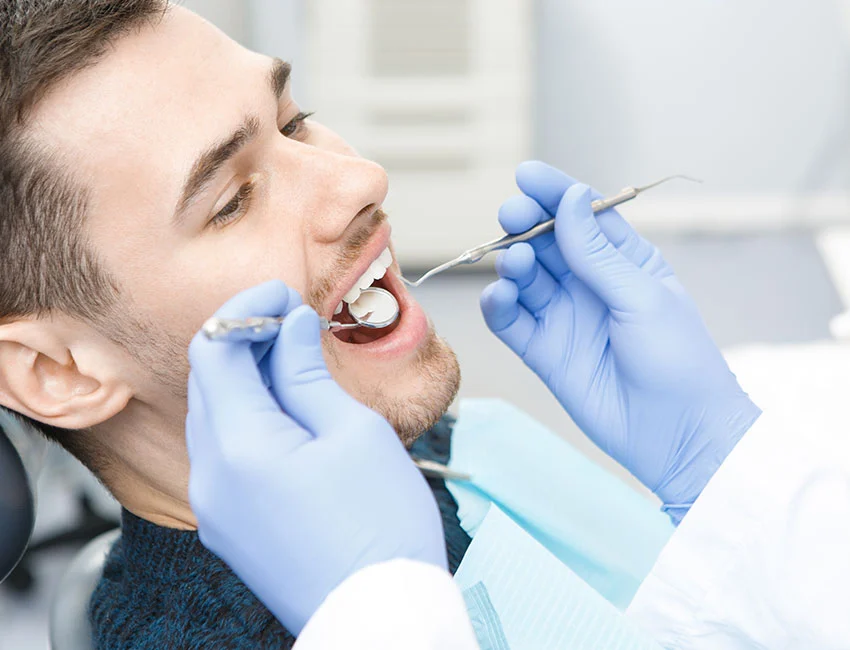
To screen for oral cancer, your dentist and hygienist conduct both a visual inspection and a physical palpation of the structures in and around the mouth. Here is what they examine at each visit:
- The lips: both the inner and outer surfaces are checked for color changes, unusual sores, or thickened tissue
- The tongue: the top, underside, and sides are examined carefully, as the sides and base of the tongue are among the most common sites for oral cancer to develop
- The cheeks and gum tissue: the lining of the cheeks and all gum surfaces are inspected for red or white patches, ulcers, or any areas that look different from the surrounding tissue
- The floor and roof of the mouth: both are checked visually and felt for any unusual lumps, masses, or texture changes
- The jaw and neck: using gentle palpation, your dentist feels for enlarged lymph nodes or any lumps that could indicate a problem extending beyond the mouth
The whole process takes under five minutes and requires nothing from the patient except opening their mouth and relaxing. Some practices also use adjunctive tools—special lights or rinses—to help visualize tissue that may not be apparent under standard lighting.
What Happens if Something Looks Unusual?
Finding something unusual during a screening does not mean a cancer diagnosis. The vast majority of findings turn out to be benign—a harmless sore, a minor irritation from a sharp tooth edge, or a tissue variation that is completely normal for that patient. The goal of the screening is to identify anything that deviates from healthy tissue and follow up appropriately.
If your dentist notices something worth monitoring, they will typically recommend a follow-up visit in one to two weeks to see whether the area has changed or resolved. If a finding is more concerning—particularly one that has not improved after two weeks, appears to be growing, or has other worrying features—a referral for further evaluation or a biopsy may be recommended.
Who Benefits Most From Consistent Screenings?
Oral cancer screenings are recommended for all adults as a standard component of routine dental care—not only for patients with known risk factors. That said, certain individuals have additional reasons to stay consistent with their checkups. Tobacco use in any form, heavy alcohol consumption, and HPV infection are the strongest known risk factors. Age also plays a role, with most diagnoses occurring in people over 40.
What makes the screening valuable for all patients, regardless of risk profile, is that oral cancer does occur in people with no identifiable risk factors. The only way to catch it early in those cases is through regular professional examination. Skipping dental visits—even for patients who feel healthy and have no symptoms—removes that opportunity entirely.
Your Regular Checkup Is Doing More Than You Think
Every time you come in for a routine exam, your local dentist is doing more than checking for cavities and cleaning your teeth. The oral cancer screening built into that visit is a quiet but genuinely valuable piece of preventive care—one that costs you nothing extra and takes only minutes, but can make an enormous difference in outcomes if something is ever found early.
If you want to learn more about dental checkups, visit our Dental Exams in Camarillo page or schedule a consultation.